Records of Respect
When we talked with Pegoretti about the new site, one of the things we had in mind from the very first conversation — a thing that's usually overlooked — was the account section. It tends to get conflated with the e-commerce account area. Shopify is ubiquitous, so you sign in to a brand you love and find yourself in a shop-app login, confused about whose house you're in — and what should be a nice user experience turns into a bit of a hell.
We wanted the opposite for Pegoretti: an account area that's the warmest room in the house.

So on the new site, your account is a home for your Pegoretti. You can add the bicycle itself — upload a photo, zero in on the details of the build, give it a real record of provenance. Colours you've saved from the Color Wall sit there too, quietly informing the next one. Measurements you've added through an inquiry are kept alongside. And for the workshop, a loop closes that's genuinely nice to see closed: a frame is made, collected, ridden — and then registered, its serial number given a home on the brand's own site.
Hundreds of records, held in abeyance
How we got there is the interesting part. Like most brands with some history, Pegoretti's data had spread — you try things over the years, and the things leave traces. One of those things was Mailchimp. Alongside the newsletter signup, a front-end form had offered a kind of pseudo-registration: fields where you could enter the details of your Pegoretti, stored against your subscriber record.
When we looked at that data, it was rich. Hundreds and hundreds of owners had used it. Some had written at length — small essays on their bicycles, what they were, how they came to be theirs. We were not going to lose those.
But how do you carry records across to a site where none of these people have an account? The answer we landed on: hold them in abeyance. The records wait, invisible, in a holding pattern. The first time an owner enters their email to sign in, the site quietly checks the held records — and if it finds one, it lifts that data out of its holding pattern, folds it into the freshly activated account, and sends the magic link. They arrive to find their bicycle already there. The essays, too — kept as the notes on the build.
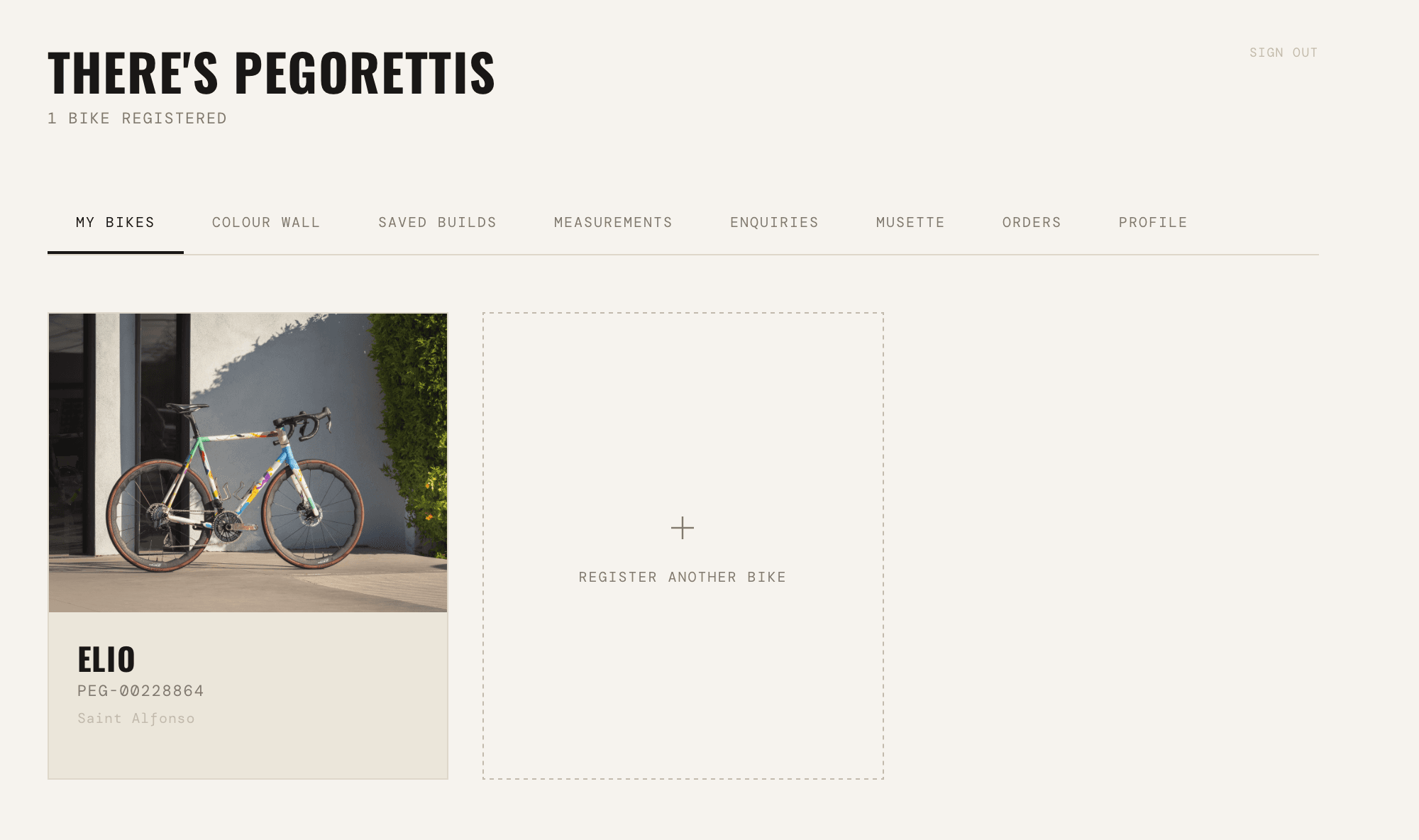
This happens on a day-to-day basis now. Some owners will notice and be delighted. Most won't think about it at all — which is better, because that's how the best technology should express itself. Not complex at the front. Just there. And not lost.
It was a respect thing
The reason we did this isn't neatness, or the capture of that horrible word, data. It's respect. Respect for the time an owner took, years ago, to write down what their bicycle is and why it matters to them. Respect for the relationship between a brand and the people who ride its work. Our industry has its refrains — silos, optimisation, efficiency, productivity — and none of them describe why this was worth doing. It was just a respect thing. And it works beautifully.
E-comm where it matters
The account area became a receipt drawer because e-commerce has a habit of overextending — of taking over every corner of a site, whether it belongs there or not. These older, almost old-world gestures — registrations, logbook entries — have a place, and they shouldn't be swamped. A site needn't be one hundred per cent e-comm. Not in our world, anyway. It should be e-comm where it matters, and something warmer everywhere else.
And it might be a problem you're having as a brand — a new site coming, and things you want to carry over. Or you'd like the account experience to be richer than the default allows. If that tickles your fancy, we should probably talk to you about headless e-commerce — and don't be scared by that. It's much easier than you think.
It wasn't neatness. It was respect — for the time the customer put in, and for the relationship it records.