Where Google Is Going.
Whether Google using more AI answers or fewer matters more or less depending on how you view Google's place in the internet, or more accurately as the internet. For good or ill, Google has become the arbiter, the guardian of the internet. Almost every search starts there, every piece of research, everything. For our part, as a monopoly, that's clearly not healthy, because it relies on the goodwill of a company, and corporations don't have goodwill. They answer to shareholders, not altruistic impulses, and they have nice words.
What Google then does with its product has a bearing on everything. Not an enormous bearing: the entirety of what everyone is doing. It changes behaviours. It boosts or drops results on the vagaries of its various software products. So any discussion of what Google is doing now with AI Overviews has to begin with its place in the market, and whether a Google-type company should even exist, and whether there might be a better way of searching for things that didn't rely on one particular company. Not competing companies; a universal index, like a library of facts. The facts are there like stones on the ground. It's how you pick them up, and how you order them and show them to people, and that's what Google was so good at back in the day, when it was natural organic results and people could grow businesses off the back of it: do the work, and appear. It's not the case now, or at least it's much more complicated.
But we're in dreamland here, and we have to deal with the world as it is, which is that Google is the dominant factor and it's in an AI arms race. Last week we read a report on two years of Google search and wrote up where the clicks went. That piece stayed inside the data. This one leads with the logical conclusions from the state of search as it is, put out there as an unveiling, this is the reality, before we take arguments and look at strategies.
The reality
Google decided, not AI. The share of results pages carrying an AI Overview went from 5.93% in September 2024 to 61.43% in August 2026, on a fixed panel of twenty million keywords re-run every month. The searches didn't change. Google changed what it does with them, in steps: questions first, then comparison, brand and buying searches through 2026.
It earns less per search for doing so. On 28 October Alphabet reported search revenue of $63.35 billion for the quarter, up 12% on the year, down from 17% growth the quarter before. On the call, Google said lower monetisation of AI Mode weighed on search growth. A year earlier it had said ads shown with AI Overviews earned the same as ads shown without them.
It's doing it anyway, and leading with a different number. The same release says year-on-year growth in search queries is the highest in five years, and that AI Mode queries are on average three times longer than traditional searches, with one in five involving voice, images or documents.
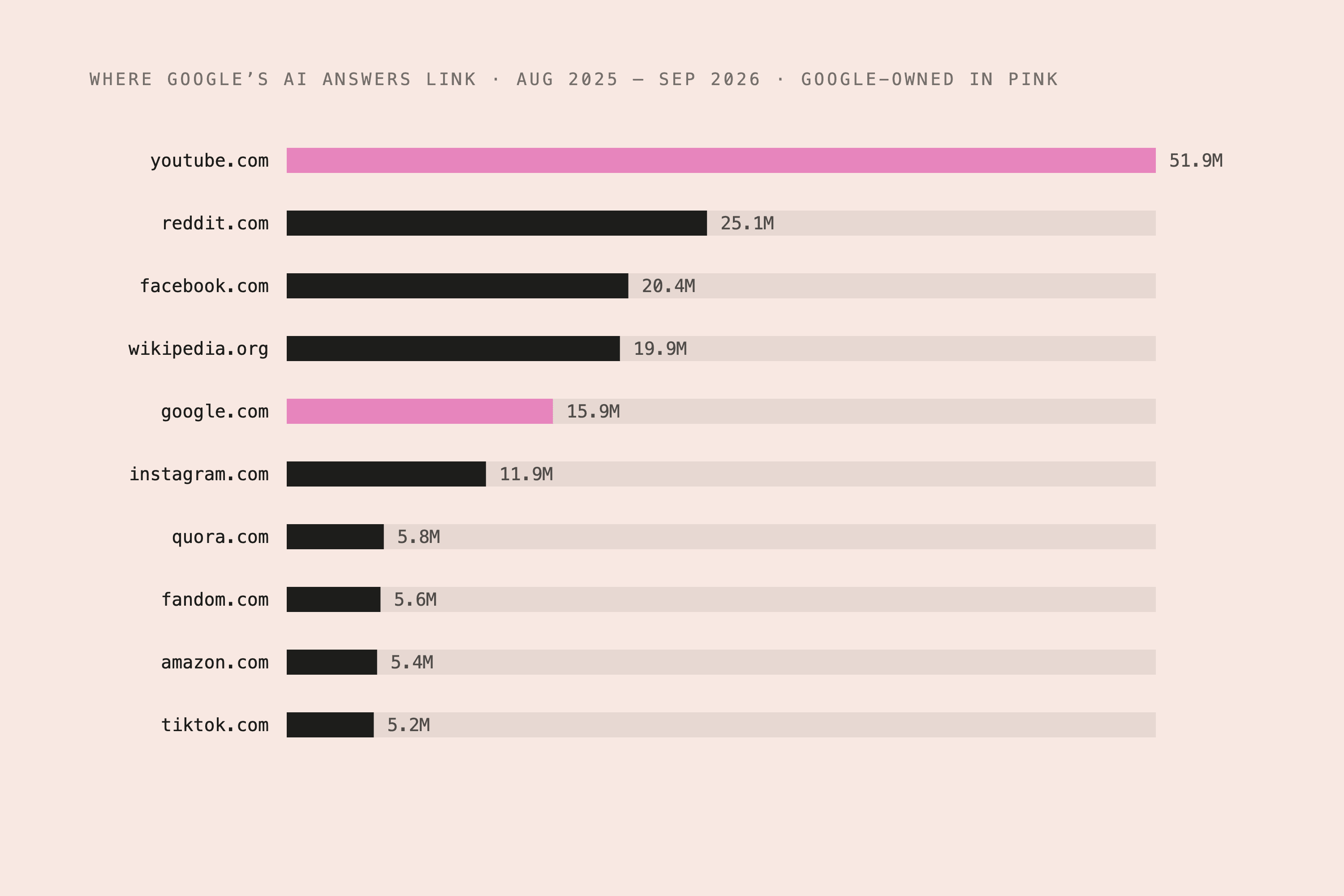
It links to the places that can't send it a bill. The ten sites Google's AI answers link to most are YouTube, Reddit, Facebook, Wikipedia, Google itself, Instagram, Quora, Fandom, Amazon and TikTok. Two of its own properties in the top five, and six of the ten are places where the content is made by users for nothing. Reuters, the Guardian, AP and the Washington Post are in ChatGPT's top thirty and not in Google's.
The publishers have noticed. Penske Media, owner of Rolling Stone, Billboard and Variety, sued Google in September 2025, saying its affiliate traffic fell by a third and that there's no way to opt out of AI Overviews short of leaving Google Search.
The ads are coming. On the same October call Google said it's scaling ads within AI Overviews and AI Mode to more users and queries.
What explains it
Probably the arms race. Google is getting a lot of data from people typing things in. Someone types something, Google provides an overview, and the hope, we imagine, is that they then go deeper and ask questions. That's how its AI is being trained. A ten-word search told Google what you wanted; a conversation three times as long, with a photograph or a document attached, tells it why. So that's probably quite beneficial, or Google deems it to be. Yet at what cost, at actual cost: the cost to Google of people not clicking paid ads. Its own numbers say the AI surfaces earn less per search, and it ships them on six searches in ten regardless. Our reading is that it values the data over the margin, for now, and that the number it chose to lead with, five-year-high query growth, says so.
The links show who it's prepared to upset. A link to YouTube is still a Google click. A link to Reddit or Wikipedia costs it nothing and starts no lawsuit. A link to a newspaper sends traffic to a business that's already in court over this. The pattern in the top ten isn't an accident of relevance; ChatGPT, drawing on the same web, reaches for Britannica, the NIH and the wire services. Google's answer is built to be self-sufficient: it summarises the publishers and links to the platforms.
The organic link is the thing being spent. When an Overview appears, the top organic result's share of clicks drops from around a third to around a fifth, and the links inside the Overview take more than two fifths. Once the ads are inside the answer too, the search doesn't need to send anyone anywhere. That's the end state the October remark about scaling ads points at: the answer carries the ad, and the click never leaves.
How long it lasts. If the hypothesis holds, that the Overview is overused not to be helpful but to train and better Google's own AI in pursuit of its product becoming dominant, then it will be there until it costs Google more than it does to keep it. How long can it put up with that pain? Until the ads inside the answer catch up with the ads beside the old ten links, or until someone on an earnings call asks why query growth isn't revenue growth. A court could shorten the timeline. And then we're back to a reordering of the many elements on the page, yet again.
What was true five years ago is still true
That you're an expert in your field, hopefully, and you have something to say that has value. There are places around the internet that reward that: Reddit, other forums, the communities interested in that thing, and they're now the places the AI answer links to. Be the page the answer has to draw on, which means saying the specific thing nobody else knows. Be present where the links go. And measure where your name appears, not only where your page ranks, which is what we built Fly Away Paul to do. The numbers behind each of these are in the companion piece.
Sources
Search data from Search Insider: 2026 Edition (October 2026). Revenue, query growth and the AI Mode remarks from Alphabet's third-quarter 2026 results and the call of 28 October, as reported by Search Engine Journal; the 2025 "same rate" remark as reported by Search Engine Roundtable. The Penske complaint as reported by Search Engine Land. The facts are theirs; the conclusions are ours.
The facts are there like stones on the ground. It's how you pick them up, and how you order them and show them to people.